
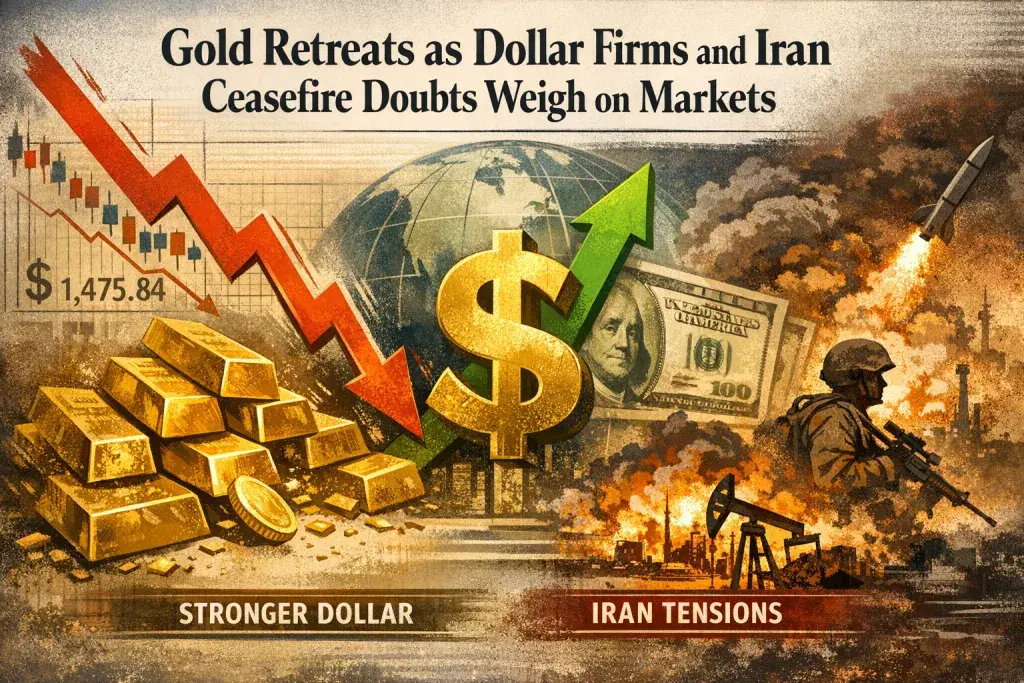
Gold slipped on April 10 as profit-booking by investors, a firmer US dollar, and lingering uncertainty over the US-Iran ceasefire agreement combined to push prices lower across both domestic and international markets. On the Multi-Commodity Exchange, gold futures for June delivery declined 0.42% to Rs. 1,52,810 per 10 grams, while spot gold in international markets fell 0.2% to $4,755.84 per ounce. Despite the single-session decline, gold has posted a weekly gain of 1.8%, reflecting how volatile sentiment has become against the backdrop of an unresolved geopolitical crisis.
What Pulled Prices Lower
The immediate pressure on gold came from two directions simultaneously. The US dollar index rose 0.10% to 98.93, a modest but consequential move: a stronger dollar makes gold more expensive for buyers using other currencies, dampening demand and creating mechanical downward pressure on prices. This relationship between the dollar and gold is well-established — the two assets have historically moved in opposite directions because gold is priced in dollars globally.
Profit-booking added to the slide. Gold had rallied sharply in the weeks prior, and traders who bought during the earlier surge chose April 10 to lock in returns. This kind of selling is not driven by a change in the underlying outlook for gold; it is simply the natural rhythm of a market that has run hard and fast. Brent crude rising 1% to $97 per barrel further supported the dollar, since oil price strength tends to reinforce dollar demand in global trade settlement.
On MCX, silver mirrored gold's direction. The May silver contract fell 0.44% to Rs. 2,42,684 per kg. In international spot markets, silver edged up 0.1% to $75.11 per ounce, a slight divergence that reflects silver's dual identity as both a precious metal and an industrial commodity. Platinum fell 1.2% to $2,077.67 per ounce, and palladium dropped 1.1% to $1,540.03.
The Iran Factor and What It Means for Gold's Longer Arc
Spot gold has fallen roughly 10% since the US-Iran conflict escalated on February 28, a decline that illustrates the complex relationship between geopolitical risk and gold prices. The conventional expectation is that gold rises during conflict. That is broadly true — but it is also true that once a conflict reaches a point of negotiation or partial resolution, investors who bought gold as a hedge begin unwinding those positions, pulling prices back.
The current uncertainty around the ceasefire agreement introduces a specific kind of risk: not the risk of escalation, but the risk of a false resolution. Markets dislike ambiguity more than they dislike clear bad news. A ceasefire that holds would likely push gold lower as the fear premium embedded in prices dissipates. A breakdown in talks would almost certainly send gold higher again, given the commodity's historical role as a store of value during periods of monetary and geopolitical stress.
The 10% decline since late February does not erase the longer-term structural case for gold. Central bank buying, persistent questions about the durability of the dollar's reserve status, and elevated sovereign debt levels across major economies have all contributed to gold's elevated price environment over recent years. These factors do not disappear because of a single week of profit-booking.
Domestic Prices Across Indian Cities
In India, the picture on April 10 was slightly more nuanced. Despite futures declining, early trade saw the price of 24K gold rise by Rs. 152, with 10 grams trading at Rs. 1,53,000. The price of 22K gold rose Rs. 140 to Rs. 1,40,250 per 10 grams. City-level pricing varied modestly:
- Mumbai and Kolkata: Rs. 1,53,000 per 10 grams (24K)
- Chennai: Rs. 1,52,730 per 10 grams (24K)
- Delhi: Rs. 1,51,630 per 10 grams (24K)
These variations reflect local taxes, dealer margins, and logistical costs rather than any fundamental difference in the underlying commodity. For Indian buyers, gold at these levels remains historically expensive, a reality that has not significantly suppressed retail demand given the metal's deep cultural and financial significance in the country.
Where Technicals Point Next
For traders watching price structure, the key levels to monitor are well-defined. Internationally, gold holds support at $4,770 and $4,730 per troy ounce, with resistance at $4,850 and $4,880. Silver's support sits at $74 and $70.70, with resistance at $78.80 and $80.40. On MCX, gold finds support at Rs. 1,51,100 and Rs. 1,49,800, and faces resistance at Rs. 1,55,000 and Rs. 1,56,600. Silver on MCX has support at Rs. 2,38,800 and Rs. 2,34,000, with resistance at Rs. 2,47,700 and Rs. 2,51,000, according to market analyst Jain.
Whether gold can reclaim the upper resistance bands will depend heavily on how the Iran ceasefire narrative develops over the coming days. A durable agreement would test the downside supports. Renewed tension would likely push prices back toward resistance. In the meantime, the week's net gain of 1.8% suggests that underlying demand for the metal remains intact, even as short-term traders take money off the table.


